

The prehistoric sites of Rajasthan are extremely important in the study of Rajasthan’s history because they present authentic evidence of the early development of human civilization, lifestyle, and cultural progress. Through the tools, remains, and paintings discovered at these sites, we can better understand the living conditions and social development of prehistoric humans.
- Definition – An archaeological site is a site from which evidence of human habitation or human physical activities in the past has been obtained.
- Process of Human Development = Hunter → Pastoralist → Agriculture
- Use of Metals by Humans = Stone → Copper → Bronze → Iron
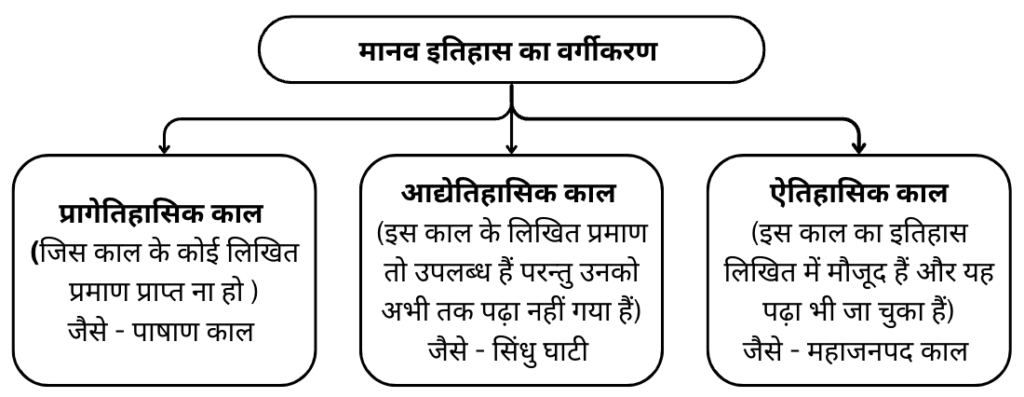
For ease of study, the period has been determined based on the use of metals by humans, which is explained in the following diagram.
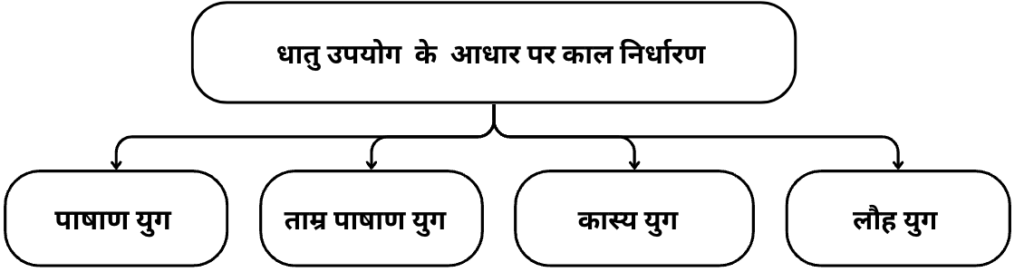
Key Facts of the Stone Age
- 1870 – C.A. Hackett –
- Hand axes and cleavers were obtained from Jaipur and Indragarh (Bundi).
- These tools are currently preserved in the Calcutta Museum.
- 1871 – A.C.L. Carlleyle –
- Started archaeological survey work in Rajasthan.
- Discovered stone tools and human skeletal remains from the Dausa region.
- 1908 – Seton Carr –
- Discovered Stone Age tools from the Jhalawar region.
- These tools indicate the technical proficiency of early humans.
- 1953–54 – Archaeological Survey of India (ASI) and Dr. Virendra Nath Mishra
- Stone tools were obtained from the riverbeds of Gambhiri and Berach rivers in Chittorgarh district.
- These tools depict the life and habitation of prehistoric man.
The Stone Age is mainly divided into three parts –
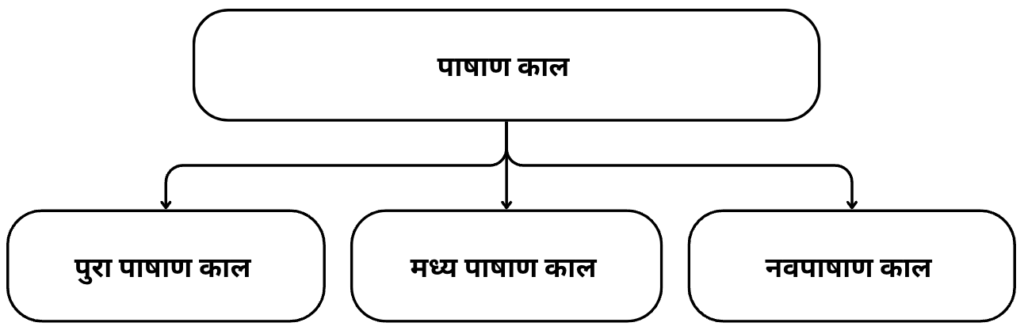
Paleolithic Age
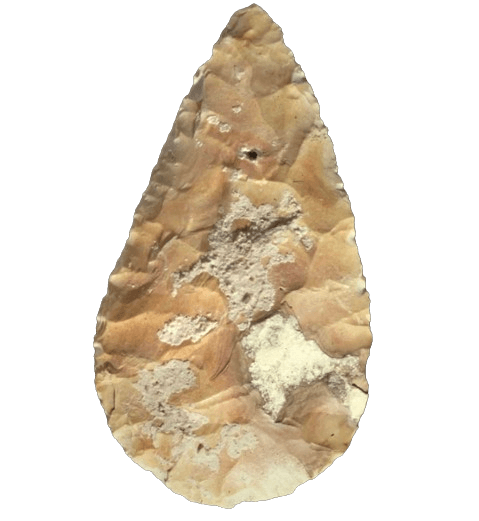
- In this period, man was a hunter, not a gatherer. The Paleolithic period is mainly divided into three parts:
- Lower Paleolithic Period
- Middle Paleolithic Period
- Upper Paleolithic Period
- Main Tools: Hand axe, chopper-chopping tools, scraper-borer, perforator, blade and burin
- Note: Quartzite, chert, jasper, etc., stones were used to make tools.
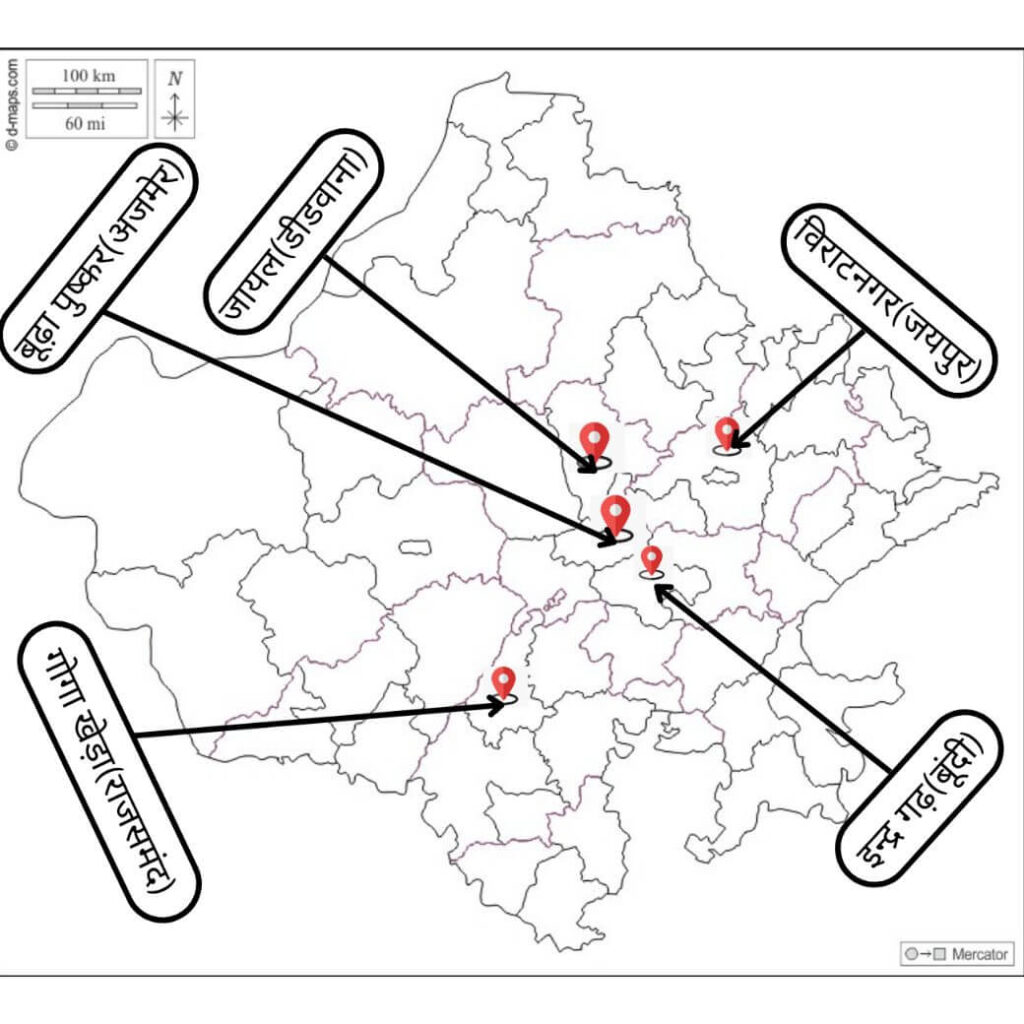
- Major Sites: Budha Pushkar, Jayal (Didwana), Indragarh (Bundi), Viratnagar (Kotputli-Behror), Goga Kheda (Rajsamand)
Mesolithic Period
- Definition: –
- The term “Mesolithic Period” was first used by Hodder Michael Westropp (H.M. Westropp).
- This period was a transitional period between the Early and Late Stone Ages.
- During this era, humans began animal husbandry along with hunting.
- Main Characteristics:
- Humans were no longer solely hunters; they began animal husbandry.
- Animal husbandry was primarily for meat consumption, not for milk or dairy products.
- They began searching for dwelling places – settling on riverbanks, in rock shelters, and caves.
- Projectile technology developed – humans made arrows, spears, knives, and bows.
- Use of microliths – small tools made by sharpening stones.
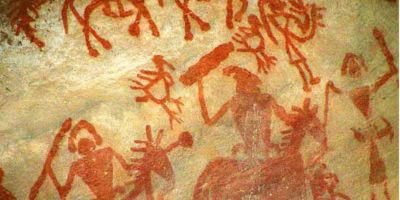
- Rock shelter art began during this period
- Humans depicted scenes of their hunting, dancing, and daily life.
- Humans were no longer solely hunters; they began animal husbandry.
- Main Tools: Microliths, small tools, bone tools, geometrically shaped tools
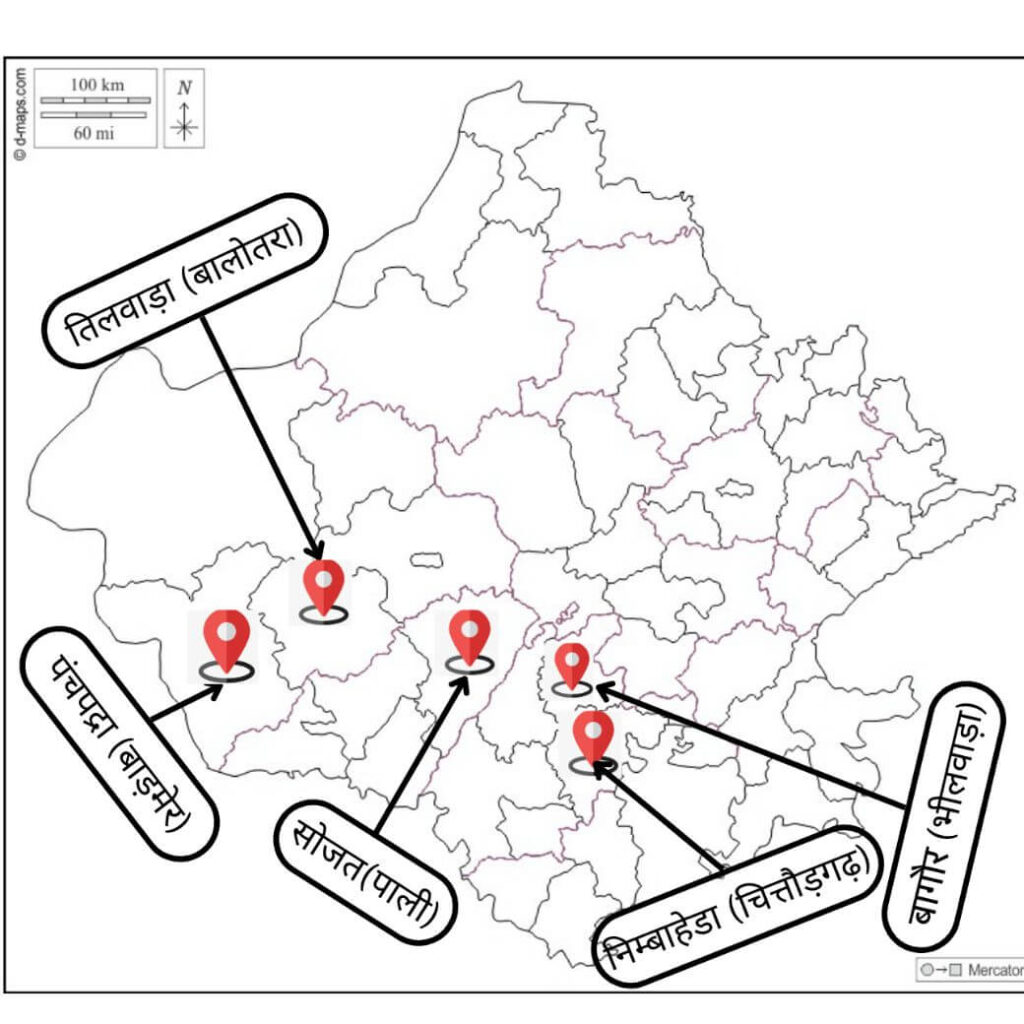
- Major Sites: Bagor (Bhilwara), Tilwara (Balotra), Sojat (Pali), Nimbahera (Chittorgarh), Panchpadra (Barmer)
Bagor (Bhilwara) 5000 BC to 500 BC
- Discoverer/Excavator: The excavation of this site was carried out from 1967-68 to 1970 by V.N. Mishra, Dr. L.C. Lesnik, and in collaboration with Deccan College, Pune.
- River Region: Kothari
- Main Characteristics:
- Nickname: Mound of Mahasatis, Museum of Primitive Culture
- The oldest evidence of animal husbandry has been found at this site.
- The tradition of placing food and pottery with the deceased by the people of this civilization proves that they believed in the concept of life after death. A large number of microliths have been found at this site.
- Both stone and bricks were used for constructing houses.
- The dead bodies were laid in a north-south direction.
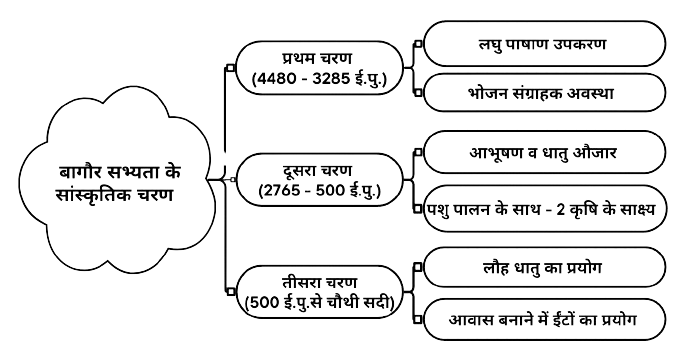
- Three cultural phases have been identified in the excavation of this site.
Note :- Evidence of Mesolithic, Chalcolithic, and Iron Age civilizations has been found, but no evidence of the Neolithic period has been obtained.
Tilwara (Balotra)
- Discoverer/Excavator – The excavation of this site was carried out in 1967-68 under the leadership of V.N. Mishra, Vijay Kumar, and L.C. Lesnik (Heidelberg University).
- River Area – Luni River
- Main Features –
- Evidence of the earliest animal husbandry has been obtained from this civilization.
- Human bone ash has been found at this site.
- Circular fire pits have been found at this site.
- Evidence of five habitation sites has been found at this site.हैं।
Neolithic Period
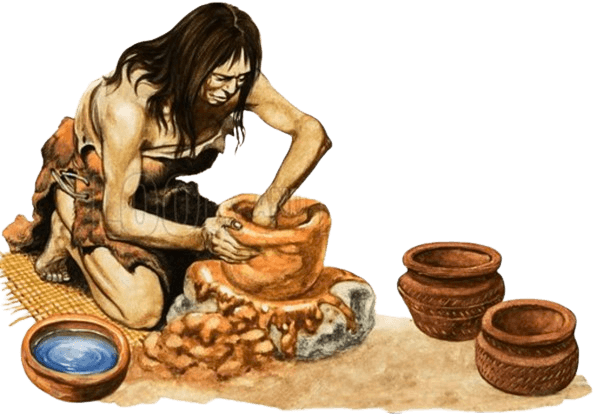
- The term Neolithic was first used by John Lubbock.
- Development of values in the human mind – development of values such as generosity, morality, kindness, compassion, greed, snatching, lying, etc.
- Beginning of agriculture
- Domestication of wild animals
- Stable rural life
- Manufacture of pottery
- Use of the potter’s wheel
- Use of polished stone tools
- Main tools: Axe, chisel, adze, grinding tools
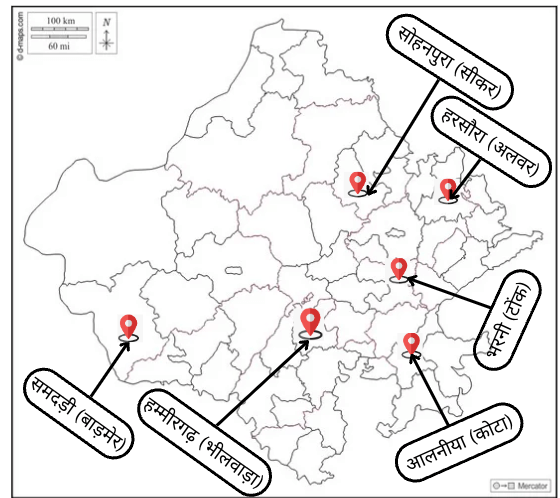
- Major sites: Viratnagar (Kotputli-Behror), Hammirgarh (Bhilwara), Bharni (Tonk), Sohanpura (Sikar), Harsora (Alwar), Samdari (Balotra), Alaniya (Kota)
Chalcolithic Period
- Definition : –
- The Chalcolithic Age was the era when humans used copper along with stone tools.
- This era is considered a transitional period between the Stone Age and the Iron Age.
- Chronology and Technological Status: –
- Technologically, the Chalcolithic civilizations are considered to be older than the Harappan civilization.
- However, chronologically, most Chalcolithic civilizations developed after the Harappan period.
- Main Features:
- A permanent rural culture developed during this period.
- Humans made agriculture and animal husbandry the main basis of their lives.
- Painting on pottery began – geometric and natural motifs were created.
- Baked bricks were not used.
- Animal husbandry was practiced only for meat not for dairy purposes (milk, ghee, etc.).
- The Chalcolithic people were unfamiliar with writing.
- Stone tools were used in conjunction with metal tools.
- Reasons for Decline:
- The main reason for the disappearance of the Chalcolithic civilizations is considered to be lack of rainfall (climatic aridity).
- These civilizations perished due to the drying up of water sources and agricultural crises.
Major Chalcolithic Cultures of Rajasthan –
Ganeshwar (Sikar) 2800 BC
- Discoverer/Excavator – R.C. Agarwal – 1972
- River – Kantli
- Main Features –
- This culture is called the mother of copper cultures.
- The people of this site exported copper to Harappa.
- Copper objects, bangles, arrows, spears, fishing hooks, etc., have been found at this site.
- The objects found at this site contain 99% pure copper.
- No copper smelting furnaces were found at this site.
- Black and blue decorated pottery, also known as ochre-colored pottery, was found at this site.
- Evidence of a stone dam was also found at this site.
- A copper pin with a double spiral head was also found at this site.
Ahar (Udaipur) 4000 BC –
- Discoverer/Excavator:
- Akshay Kirti Vyas – 1953 .
- V.N. Mishra,
- Ratan Chandra Agrawal
- Dr. H.D. Sankalia .
- P.L. Chakravarti – 1961-62.
- River – Ahar/Berach
- Main Features:
- Also known as the Banas culture due to its proximity to the Banas River.
- Nicknames: Tamravati, Aghatpur, Aghat Durg, Dhulkot
- The people of this site used black schist grinding stones for grinding grains, which were placed inside the foundations of their houses.
- The inhabitants of this site used stones and sun-dried bricks in house construction.
- A terracotta figurine of a bull (Banasian Bull) has been found at this site.
- Six Greek copper coins dating from the 3rd century BC to the 1st century BC ,three seals, and lapis lazuli have been found at this site.
- The people of this site buried the deceased with ornaments.
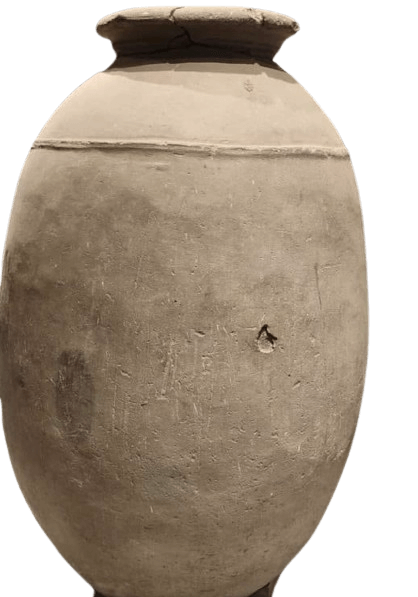
- Large earthenware vessels for storing grain have been found, which were known as Gore/Kothe/Kathe.
- Iranian water vessels have also been found at this site.
- Evidence of printing blocks has also been found at this site.
- The seals found at this site bear the image of the Greek god Apollo.
- Weights for weighing have been found at this site, indicating that commerce was in an advanced state.
- Evidence of 6-7 hearths has been found at this site, suggesting the existence of a joint family system.
Rang Mahal (Hanumangarh) 1000 to 300 BCE
- Discoverer/Excavator – Archaeological team from Lund University, Sweden, led by archaeologists Hanna Rydh, Holger, and Arbman – 1952-54
- River – Ghaggar River
- Key Features –
- Dr. Luigi Pio Tessitori discovered terracotta figurines from the early Gupta period here in 1918.
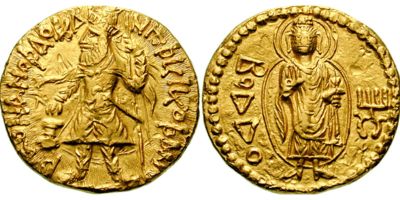
- Punch-marked coins of Kanishka I and Kanishka III have been found here.
- 105 copper coins have been found here.
- Sculptures of guru and disciple, and Gandhara style sculptures have been found.
- Bell-shaped pottery, spouted pitchers, cups, bowls, lids, lamps, lampstands, and incense burners have been found here.
- A small clay toy cart with wheels has been found here.
- The oldest evidence of Krishna Leela has been found here.
Ojhiyana (Beawar)
- Discoverer/Excavator – B.R. Meena and Alok Tripathi (1999-2000)
- River – This site is not located on a riverbank but on a hillside.
- Key Features –
- A large saddle quern was found on the floor for grinding.
- This site is related to the Ahar civilization.
- Terracotta figurines of bulls and cows with white markings have been found here.
- Carnelian, faience, stone beads, shell, and copper bangles have been found here.
Lachhura (Bhilwara)
- Discoverer/Excavator – Excavation was carried out in 1998-99 by B.R. Singh, S.C. Saran, and Kanwar Singh under the direction of B.R. Meena.
- River – This civilization is located in the bed of the Hanuman Nala (stream), which is a tributary of the Mansi River.
- Main Features –
- The archaeological remains found here can be mainly divided into four parts:
- Pre-Buddhist period
- Mauryan period
- Shunga period
- Kushan period
- A terracotta figurine of a woman in the Lalitasana posture has been found here.
- Four letters in Brahmi script are inscribed on the clay seals found here.
- The archaeological remains found here can be mainly divided into four parts:
Gilund Civilization (Rajsamand)
- Discoverer/Excavator – Excavation work was started in 1957-58 under the direction of B.B. Lal.
- Excavation work was carried out from 1998 to 2003 under the direction of Prof. V.S. Shinde of Pune University and Gregory Louis Possehl of the University of Pennsylvania (USA).
- River – Banas
- Main Features –
- The excavation site of the Gilund civilization is known as Modia Magri.
- Remains of granaries/storage rooms for storing grain have also been found between the walls.
- Animal bones have been found at this site, suggesting that the inhabitants of Gilund were meat-eaters.
- Grains of wheat have also been found in a pot at this site.
- Five types of pottery (black, polished, plain, brown, and red) have been found at this site.
- Terracotta toys, stone marbles, copper tools, and remains of ivory bangles have been found at Gilund.
- The pottery shows both geometric and naturalistic ornamentation.
- The Gilund civilization is considered a sub-branch of the Ahar civilization.
- In the Ahar civilization, burnt bricks were not used in building construction, but in the Gilund civilization, burnt bricks were used extensively.
The Bronze Age of Rajasthan and the Development of Civilizations
- Definition : –
- The Bronze Age is the period when humans began the manufacture and use of bronze (copper + tin alloy).
- This era was a transitional period after the Chalcolithic period and before the Iron Age.
- The civilization of this era is often called the “Golden Age of the Metal Age”.
- Technological Progress:
- With the discovery of metal smelting, humans combined copper and tin to produce bronze.
- This made agricultural implements, tools, weapons, and ornaments stronger and more useful.
- In this era, humans also developed a writing system, which led to more organized administration and trade.
- Social and Economic Changes:
- The development of metal production and trade led to the formation of densely populated societies.
- Humans now began to live in permanent settlements.
- The process of social stratification began – society was divided into the ruling class, priestly class, merchant class, and labor class.
- Organized states were established, indicating early forms of governance.
- Trade routes expanded→the exchange of metal goods increased.
- Cultural Characteristics:
- Metal was widely used in art and architecture.
- Skill in sculpture and jewelry making increased.
- Urban planning and irrigation systems began in this period.
- The Harappan civilization (Indus Valley Civilization) is considered a major and developed culture of this period.

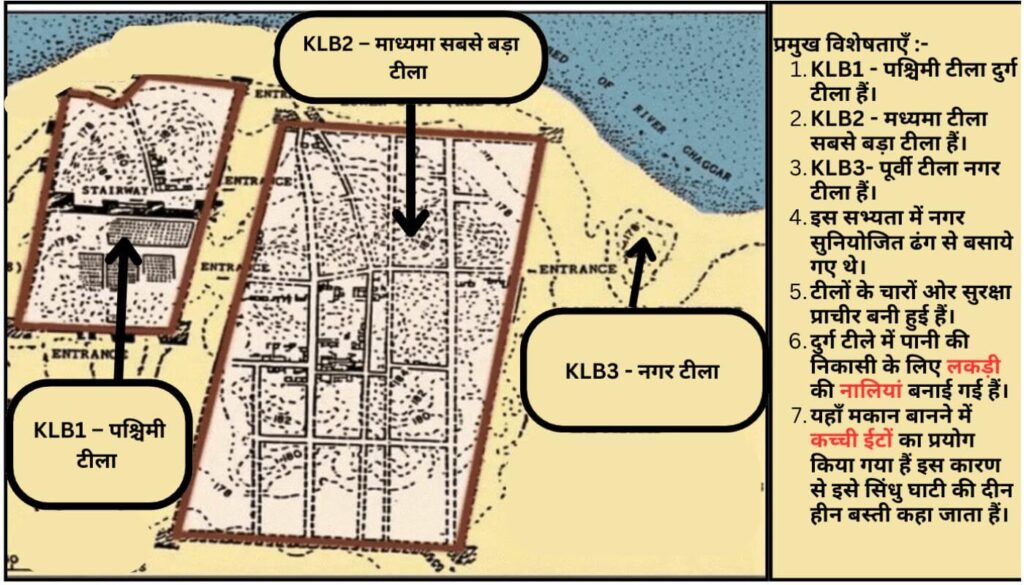
Kalibangan Civilization / Indus-Saraswati Civilization (Hanumangarh)
- Discoverer/Excavator:
- Amalananda Ghosh discovered this archaeological site in 1952 AD.
- The excavation of this site was carried out between 1961 and 1969 AD under the direction of Shri B.B. Lal, Shri B.K. Thapar, Shri D. Khare, K.M. Srivastava, and Shri S.P. Srivastava.
- Note: Dasharatha Sharma called Kalibangan the third capital of the Indus Valley Civilization.
- River: Ghaggar River (Ancient Saraswati River)
- Main Features:
- Five cultural phases have been found in the excavations here.
- This place is called ‘Kalibangan’ because of the black bangles made of copper found here.
- Evidence of decorated bricks has been found here.
- The oldest evidence of an earthquake has been found here.
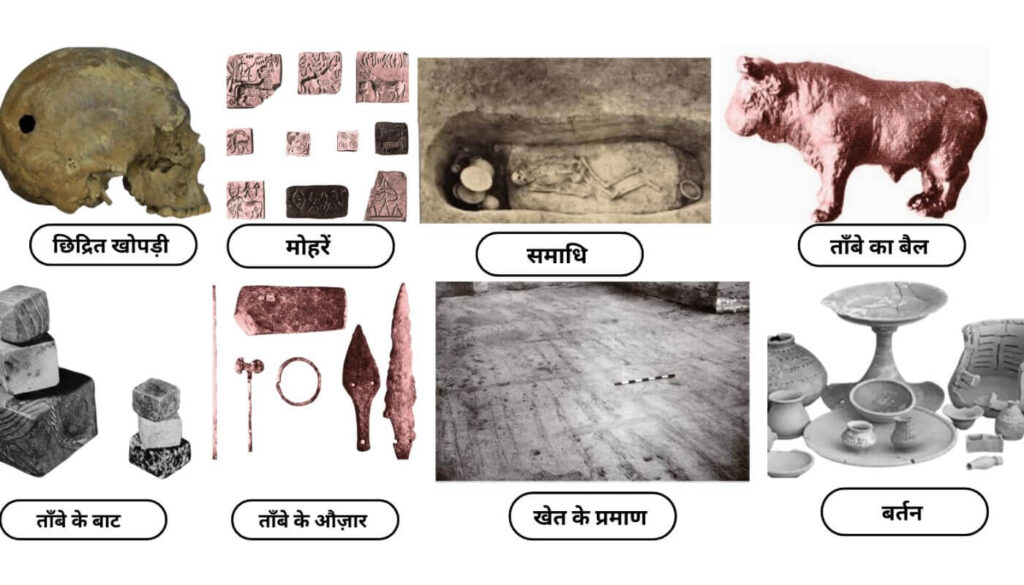
- Evidence of brain surgery (a child’s skull with 6 holes)
- The script here was written from right to left.
- The excavations here have yielded small stone tools, clay beads, conch shells, glass and clay bangles, toys, cartwheels, a broken terracotta figurine of a bull, grinding stones, etc.
- Weapons made of copper metal have been found here. This shows that the people were familiar with weapons and copper metal.
- Agriculture –
- Evidence of a double-ploughed field has been found here.
- Evidence of two crops being grown simultaneously has also been found here – chickpeas and mustard.
- Evidence of other major crops: mustard, chickpeas, rapeseed, millet, wheat, barley, cotton.
- This site was known as a region producing abundant grains in Vedic literature.
- A copper bull figurine has been found here.
- Seals–
- Steatite seals and small clay seals have been found here.
- Reed-shaped figures have been found imprinted on clay seals.
- The seals found here resemble those from Mesopotamia.
- Cylindrical Greek seals have also been found here.
- Commerce –
- The stone weights found here indicate that the people used weights for weighing. (An indication of developed commerce)
- The discovery of foreign materials suggests that the inhabitants of Kalibangan had trade relations with foreigners.
- Religious beliefs –
- Seven fire altars have been found.
- Swastika symbols have been found on pottery from Kalibangan.
- Three methods of burial were prevalent here: complete burial, partial burial, and cremation.
- The Bronze Age and Development of Civilization in Rajasthan
- The Kalibangan Archaeological Museum was established in 1983.
- This archaeological museum houses the artifacts obtained from the excavations carried out in Kalibangan between 1961 and 1969.
- Mounds found in Kalibangan
Images of artifacts found at Kalibangan
Baror (Sri Ganganagar) archaeological site
- Discoverer/Excavator –
- This archaeological site of Baror was identified in 1916-17 by Luigi Pio Tessitori.
- After India’s independence, Amalananda Ghosh (former Director General, Archaeological Survey of India) conducted a detailed survey of this site.
- Excavation work at this site began in 2003.
- River – Ghaggar River
- Main Features –
- This civilization is considered to be Pre-Harappan and Mature Harappan.
- Approximately 8000 steatite beads were found in a single pot at this archaeological site.
- Lapis lazuli beads have been found at this site, which are only found in Afghanistan; it is possible that the inhabitants of Baror imported these beads from Afghanistan.
- A major characteristic of this civilization is the evidence of planned city layout, the use of sun-dried bricks in building construction (similar to the Kalibangan civilization), and an industry-based economy.
- The pottery found at this site contains black clay, which is its distinctive feature.
- Carved bangles, rings, and borla (a type of head ornament) have also been found at this site.
- Button-shaped seals have also been found at this site.
Sothi (Bikaner) Archaeological Site
- Discoverer/Excavator –
- This site was discovered by Luigi Pio Tessitori.
- Excavation work at this site was carried out under the direction of Amalananda Ghosh.
- Other personalities – Aurel Stein, Kshetrems Dalal
- River – Ghaggar and Chautang River
- Main Features –
- Based on the pottery found at this site, it has been classified as a separate archaeological culture/subculture.
- The pottery found at this site features depictions of peepal leaves and fish scales.
- This site is also known as Kalibangan I.
- Remains of this culture have been widely found in Rajasthan, Haryana, and Indian Punjab.
Iron Age Archaeological Site
Bairat (Kotputli-Behror) Archaeological Site
- Discoverer/Excavator –
- The initial discovery was made in 1837 AD by Captain Burt.
- The excavation of Bairat was carried out under the leadership of Dayaram Sahni in 1936-37 AD by Neelratna Banerjee and Kailashnath Dixit.
- River – Banganga River
- Key Features –
- It was the capital of the Matsya Mahajanapada – Viratnagar or Bairat.
- Archaeological evidence has been found on the hills near Bairat.
Bhabru Inscription –
- In 1837, Captain Burt discovered Ashoka’s Bhabru inscription from Bijak Hill.
- The Bhabru inscription uses the Shankha script.
- The Bhabru inscription suggests that Ashoka was a follower of Buddhism.
- The Bhabru inscription mentions the three jewels of Buddhism – Buddha, Dhamma, and Sangha.
- Currently, this inscription is preserved in the Calcutta Museum. हैं।
Temples of Bairat –
- In 1936, during the excavation of Bairat, Dayaram Sahni found the remains of a circular Buddhist temple and a chaitya.
- An inscription of the Shaka Samvat 1509, found in the complex of the circular Buddhist temple, provides information about its construction.
- A 16th-century Parshvanath temple also exists in Bairat.
- A Sati inscription of Vikram Samvat 1743 is also present.
- The stupas and temples found at Bairat were constructed of bricks, despite the availability of stone.
- The bricks are similar in structure to those of Mohenjo-daro.
The Second Inscription of Bairat:
- This short inscription was discovered by Carlyle in 1871-72.
- It is a copy of Ashoka’s Rupnath and Sahasram inscriptions.
- The script of this inscription is Brahmi.
- Currently, it is illegible due to the effects of time.
- Chinese traveler Xuanzang:
- In his travelogue, Xuanzang mentions eight Buddhist monasteries in Bairat.
- The Chinese traveler Xuanzang visited Bairat to see the ruins of the Buddhist monasteries.
- In the Si-Yu-Ki, Xuanzang mentions two sites in Rajasthan: Bairat and Bhinmal.
- Mughal connection with Bairat:
- Akbar’s general, the ruler of Amer, Man Singh, constructed a gateway in Bairat, which is known as the Mughal Gate (Akbar’s resting place).
- The ruler of Amer, Man Singh, also built a garden here.
- There was a mint here during the Mughal period.
- Bairat was Akbar’s favorite hunting ground.
- Other facts about the Bairat archaeological site:
- Excavation work was carried out here during the time of Maharaja Ram Singh II of Jaipur. A golden casket was found during this excavation.
- Buddhist relics were found in this golden casket.
- 36 coins wrapped in cotton cloth were found in Bairat.
- Of these coins, 28 belong to Indo-Greek rulers (16 of Menander) and 8 are punch-marked coins.
- Bairat was destroyed by Mihirakula.
Bhinmal (Jalore) Archaeological Site
- Discovered/Excavated by R.C. Agrawal in 1953-54 AD.
- Other facts about the Bhinmal archaeological site:
- The ancient name of Bhinmal was Shrimāl/Shrimal.
- The Chinese traveler Xuanzang visited Bhinmal and referred to it as Pilomolo.
- Coins of the Shaka Kshatrapas (feudatories of the Shaka rulers) have been found at Bhinmal.
- Foreign influence is visible on the pottery found here.
- A Greek wine flask has been found here, suggesting that Bhinmal had trade relations with Greece.
- A Roman wine vessel has also been found here.
- This site is the birthplace of the famous mathematician-astronomer Brahmagupta.
- It is also the birthplace of Magha, the author of the epic poem Shishupala Vadha.
- This was the early capital of the Gurjara-Pratihara kingdom.
Balathal Civilization (Udaipur)
- Discoverer/Excavator –
- This site was discovered in 1961-62 AD by V.N. Mishra.
- The excavation of this site was carried out in 1993 AD under the leadership of V.N. Mishra.
- River Basin – Berach River (in the tributary valleys of the Banas River)
- Main Features –
- Two cultural phases have been found in the excavation of the Balathal archaeological site – 1. Chalcolithic Age 2. Iron Age
- Many terracotta figurines of bulls have been found at this site.
- Unrefined pottery, which was not fully fired, has been found at this site.
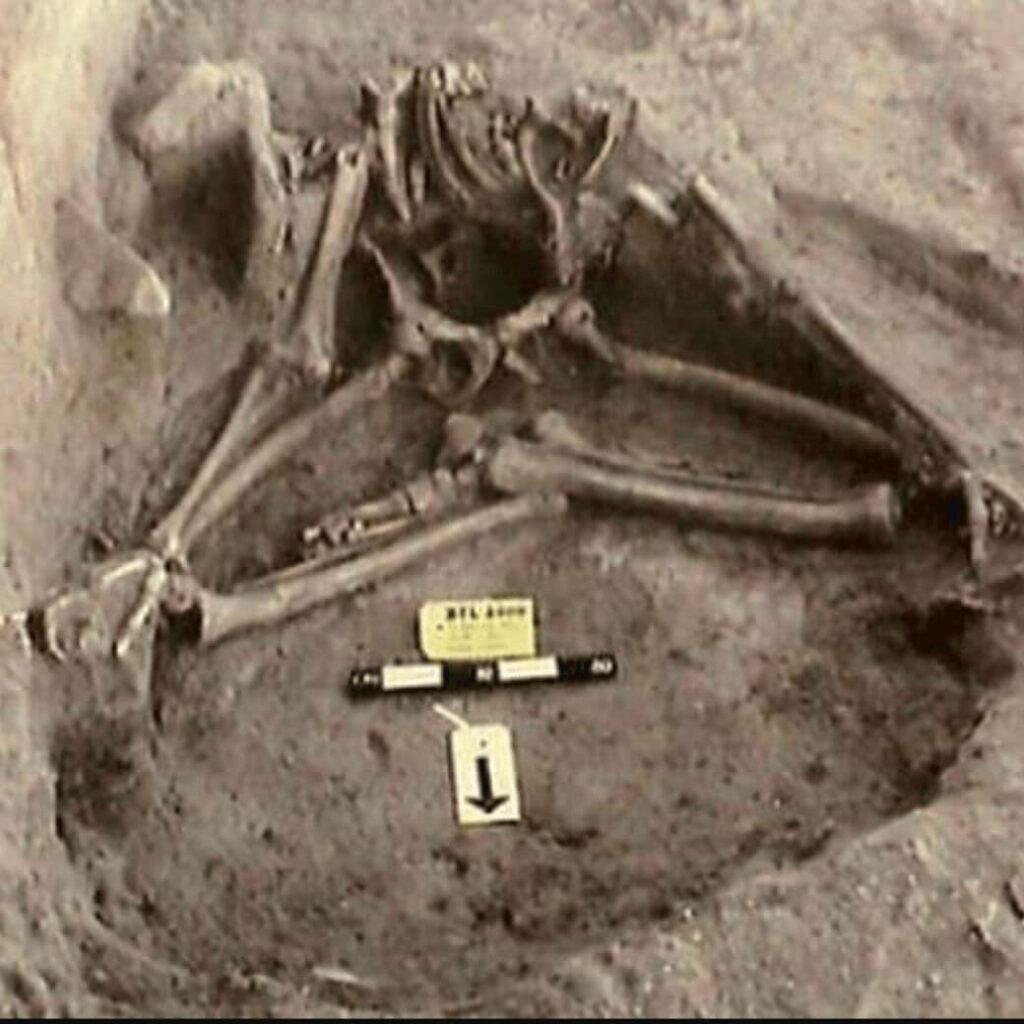
- Burials in a yogic posture have been found at this location.
- Copper tools bearing the images of elephants and the moon have been found here.
- A hand-woven cloth dating back to the 5th century BCE has been found at this site.
- A skeleton of a leprosy patient dating back to 4000 BCE has been found at this site.
- Iron tools have been found in abundance at this site.
- Five iron smelting furnaces have been found at this site.
Nagari Civilization (Chittorgarh)
- Discoverer/Excavator –
- This archaeological site was discovered in 1870 CE by the archaeologist Carlyle.
- This site was excavated in 1919-20 CE by Dr. Bhandarkar, and in 1961-62 CE by Soundararajan and the Central Archaeological Department of India.
- River Region – Berach
- Main Features –
- This site is identified with Madhyamika mentioned in Panini’s Ashtadhyayi.
- Coins of the Shivi Janapada have been found at this site.
- A Kushan-era defensive wall has been found at this site.
- Inscribed stones, decorated bricks, terracotta figurines, etc., have been found at this site.
- Remains of a Gupta-era temple have been found at this site, which houses an idol of Shiva.
- A male head showing Greek-Roman influence has been found.
- Evidence of four circular wells has been found at this site.
Sunari (Jhunjhunu)
- Discoverer/Excavator – The excavation work at this site was carried out by the Rajasthan Archaeological Department in 1980-81 CE.
- River Region – Kantli River
- Main Features –
- Evidence of the oldest iron smelting furnaces has been found at this archaeological site.
- The people of this civilization used rice in their diet.
- Evidence of horses pulling chariots has been found from the inhabitants of this civilization.
- Remains of Shunga, Mauryan, and Kushan period cultures have been found at this archaeological site.
- A terracotta figurine of the Mother Goddess and a granary have been found at this site.
Noh (Bharatpur) Archaeological Site
- Discoverer/Excavator:
- The excavation work at this archaeological site began in 1963-64 under the direction of Ratan Chandra Agrawal.
- The excavation work at this archaeological site continued in seven phases from 1963 to 1972.
- The material found at this site has been dated to 1100 BC to 900 BC using the radiocarbon dating method.
- River Area: Ruparel River
- Main Features:
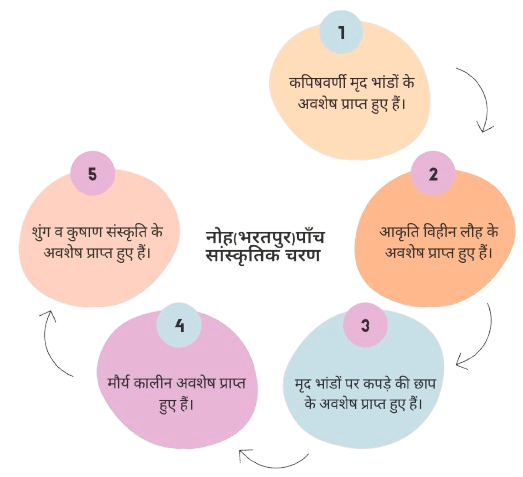
- Five cultural phases have been found at this site.
- A large stone statue, known as Jakha Baba, has been found at this site.
- Coins of Huvishka and Vasudeva Kushan have also been found at this site.
- The most important aspect of this archaeological site is that remains of the Chalcolithic, Vedic, and Mahabharata period cultures have been found here.
- Along with agricultural implements, the remains of 16 ring wells have also been found at this site.
Nagar (Tonk) Archaeological Site
- Discoverer/Excavator:
- This archaeological site was discovered by A.C.L. Carlleyle in 1871-72 AD.
- Krishna Deva and K.V. Soundararajan are also associated with the excavation of this archaeological site.खोज कर्त्ता /उत्खनन कर्त्ता –
- Key Features:
- 6000 copper coins of the Malava tribe were found at this site, suggesting that a mint of the Malava Janapada (republic) may have been located here.
- The credit for the discovery of these coins goes to A.C.L. Carlleyle.
- These coins were studied by Vincent Smith.
- Artistic grain storage jars have been found at this archaeological site.
- A statue of Indra and Indrani and Kamadeva and Rati from the Shunga period has been found at this site.
- A statue of Mahishasuramardini from the post-Gupta period, a one-faced Shiva lingam, and statues of Lakshmi, Ganesha, Durga, etc., have also been found at this site.
- 6000 copper coins of the Malava tribe were found at this site, suggesting that a mint of the Malava Janapada (republic) may have been located here.
Redh (Tonk) Archaeological Site
- Discoverer/Excavator – This archaeological site was excavated in 1938 by Dayaram Sahani and K.N. Puri.
- River Region – Dhel/Dheel River
- Key Features –
- A large number of iron tools have been found at this site, due to which this site is called the “Tata Nagar of ancient India”.
- 3075 punch-marked coins have been found at this archaeological site. Among these coins, those of the Malava and Mitra rulers, Indo-Greek coins, and a fragmented coin of the Greek ruler Apollodotus are prominent.
- Remains of 115 ring wells have been found at this site.
- A lead coin found at this site bears the inscription “Malava Janapada,” which proves that this region was under the dominion of the Malava Janapada.
- A lead seal inscribed with “Janapadasya” has also been found.
- Steatite boxes (similar to those used by Buddhist monks) have been found at this site
Archaeological Sites of Rajasthan at a Glance
| Civilization / Period | Major Archaeological Sites (Rajasthan) | Major Characteristics |
Paleolithic Age | Jayal (Didwana), Indragarh (Bundi), Viratnagar (Kotputli-Behror), Goga Kheda (Rajsamand), Budha Pushkar | Hunter-gatherers Nomadic lifestyle |
| Mesolithic Age | Bagor (Bhilwara), Tilwara (Balotra), Sojat (Pali), Nimbahera (Chittorgarh), Pachpadra (Barmer) | Beginning of animal husbandry Use of microlithic tools |
| Neolithic Age | Viratnagar (Kotputli-Behror), Hammirgarh (Bhilwara), Bharni (Tonk), Sohanpura (Sikar), Harsora (Alwar), Samdari (Balotra), Alaniya (Kota) | Beginning of agriculture Manufacture of pottery Stable rural life Invention of wheel Use of fire |
| Chalcolithic Age | Nandlalpura, Kiradot, Chauthi Bari (Jaipur), Sawaniya, Pungal (Bikaner), Kurada (Didwana), Pind Paladiya (Chittorgarh), Ganeshwar (Sikar), Palana (Jalore), Kol Maholi (Sawai Madhopur), Malah (Bharatpur), Jhadol (Udaipur) | Painted pottery Use of copper |
| Bronze Age | Kalibangan (Hanumangarh), Baror (Sri Ganganagar), Sothi (Bikaner) | Metal smelting Rise of organized urban states |
| Iron Age | Bhinmal (Jalore), Chak-84, Tarkhanwala Dera (Sri Ganganagar), Noh (Bharatpur), Viratnagar, Jodhpura, Sambhar (Jaipur Rural), Sunari (Jhunjhunu), Iswal (Udaipur), Nagari (Chittorgarh), Nagar, Redh (Tonk), Nainwa (Bundi) | Agricultural development Manufacture of hard and strong iron tools |



